
OSMX Mining
Community contribution is key to the OSMX project’s success. For this, we need miners to:
- Capture data:
- Process the data.
- Serve the data.
For this, they are rewarded with OSMX tokens.
Capture Data – Use your smartphone as a dashcam
Modern smartphones have extremely high-quality cameras that are far superior to those in dashcams. For this reason, OSMX repurposes your smartphone into a data mining supercomputer.
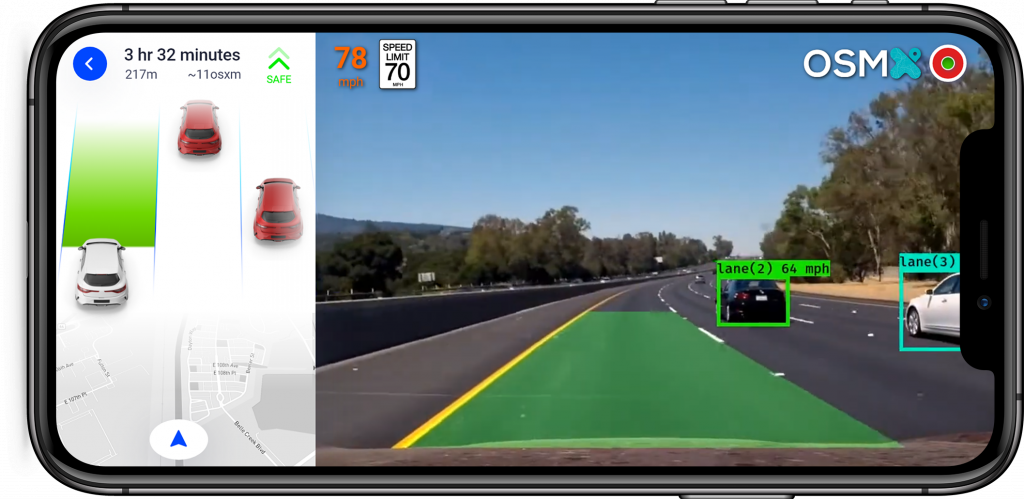
Drivers use the OSMX app as an in-car dash cam, recording GPS and high-quality 4K video and imagery data while on the road. The app runs on all modern smartphones, requiring no specialized hardware.
Drivers are rewarded for their contributions with OSMX tokens for creating the maps, and perpetual rewards based on commercial usage of the data.
Requirements
In order to produce acceptable quality footage, the minimum requirements are:
- A smartphone with at least a 4K camera
- A data plan with sufficient available data for OSMX ~2-5Gb per hour for live upload
- Sufficient data storage for WIFI upload when available upload
- A high-quality dash mount that is stable and has a good view of the road with minimal hood in view.
Server Hosting Mining
Commercial users can also provide ongoing OSMX map compute nodes, this also uses a docker container that makes use of the miners CPU, GPU and storage to create a decentralised mapping platform to host the OSMX Compass family of services.
The data server docker container runs a full suite of GIS services providing:
- Map Tile Server – Vector and image tiles for specific regions or the entire globe.
- Search Service – Forward and reverse geocoding along with fuzzy text search
- Telematics Service – High performance batch reverse geocoding and route fitting of GPS traces.
- Route Planner – Point to point with via stop routing, live and historic traffic data sets are used for accurate travel times where available.
- Route Optimiser – Comprehensive multi-vehicle fleet route optimiser and API service for distance/time matrix calculation, which also uses live and historic traffic data sets where available.
- Operating System: macOS, Windows (64-bit), or most Linux distributions (Red Hat, Ubuntu, and Debian supported).
- CPU: 64-bit x86_64, 8+ cores.
- Disk: SSD / NVMe (10,000 IOPS sustained – not burst or peak – or better). Minimum 1TB for the vector partition. Do not use Amazon Elastic Block Store (AWS EBS) because its latency is too high to sync reliably.
- Disk: Imagery SAS / SSD /NVMe (2000 IOPS sustained) 50TB minimum for single region hosting, ~12.5PB for all region hosting.
- RAM: 16 GB+.
Amazon EC2’s i3.2xlarge VM size may be appropriate depending on your workload. A fast network connection is preferable. Any increase in a server’s client-handling load increases resources needs.